The ED Solution That Doesn't Require a Prescription
Erectile dysfunction affects an estimated 52% of men between the ages of 40 and 70—and yet most men who experience it either suffer in silence or immediately reach for pharmaceutical solutions. What very few men know is that one of the most effective, evidence-backed treatments for ED requires nothing more than a few minutes a day and zero equipment.
Pelvic floor exercises—commonly known as Kegels—have been shown in clinical research to significantly improve erectile function in men. In one landmark study, men who performed pelvic floor exercises twice daily for three months, combined with basic lifestyle changes, saw dramatic improvements in erectile function—with some achieving complete recovery.
The problem? Most men have never heard of male Kegels. And those who have often dismiss them as "exercises for women." That misconception is costing men their sexual confidence and quality of life.
This guide will change that. You'll learn exactly what your pelvic floor muscles are, why they're critical for erections, and how to build a simple daily routine that can start producing results within weeks.
For a comprehensive overview of natural approaches to erectile dysfunction, see our lifestyle changes to naturally reverse erectile dysfunction guide.
What Is the Pelvic Floor and Why Does It Matter for Erections?
Think of your pelvic floor as a hammock of muscle and connective tissue that stretches from your pubic bone at the front to your tailbone at the back. This muscular hammock supports your bladder, bowel, and—critically for this discussion—plays a central role in sexual function.
In men, the pelvic floor muscles are directly involved in three aspects of erectile function:
1. Trapping blood in the penis: The ischiocavernosus and bulbocavernosus muscles—two key pelvic floor muscles—compress the veins that drain blood from the penis during an erection. When these muscles are strong and functioning properly, they help maintain the hydraulic pressure needed for a firm, lasting erection. When they're weak, blood drains too quickly, resulting in softer erections or difficulty maintaining them.
2. Ejaculatory control: The same muscles that help maintain erections also control ejaculation. Strengthening them can improve both erectile rigidity and ejaculatory control—addressing two of the most common sexual concerns for men over 40 simultaneously.
3. Urinary continence: While not directly related to ED, pelvic floor strength also affects urinary control. Many men over 40 experience some degree of urinary urgency or leakage, and Kegel exercises address this as well.
The connection is clear: weak pelvic floor muscles = weaker erections. Stronger pelvic floor muscles = better erectile function. It's that direct.
Why Men Over 40 Are Particularly Vulnerable to Pelvic Floor Weakness
Several factors that become more common after 40 contribute to pelvic floor weakness:
Sedentary lifestyle: Prolonged sitting—whether at a desk, in a car, or on a couch—weakens the pelvic floor over time. The muscles simply don't get the activation they need to stay strong.
Weight gain: Excess abdominal weight increases pressure on the pelvic floor, gradually weakening the muscles. This is one reason why obesity is such a significant risk factor for ED.
Reduced physical activity: As men become less active with age, overall muscle tone declines—including pelvic floor muscle tone.
Prostate issues: Prostate enlargement (BPH) and prostate surgery can both affect pelvic floor function and contribute to ED. Kegel exercises are frequently recommended as part of recovery after prostate procedures.
Vascular changes: While not directly a pelvic floor issue, the vascular changes that contribute to ED (reduced blood flow, arterial stiffness) interact with pelvic floor function. A strong pelvic floor can partially compensate for reduced vascular efficiency by more effectively trapping available blood flow.
For more on the relationship between vascular health and erectile function, read our guide on the link between ED and heart health.
How to Find Your Pelvic Floor Muscles
Before you can exercise your pelvic floor, you need to find it. This is the step most men skip—and it's why many men who "try Kegels" don't see results. They're contracting the wrong muscles.
Method 1: The urine stop test
The next time you urinate, try to stop the flow mid-stream. The muscles you use to do this are your pelvic floor muscles. Important caveat: do this only once or twice to identify the muscles. Do NOT make a habit of stopping urine flow during urination—this can interfere with normal bladder function over time.
Method 2: The gas prevention technique
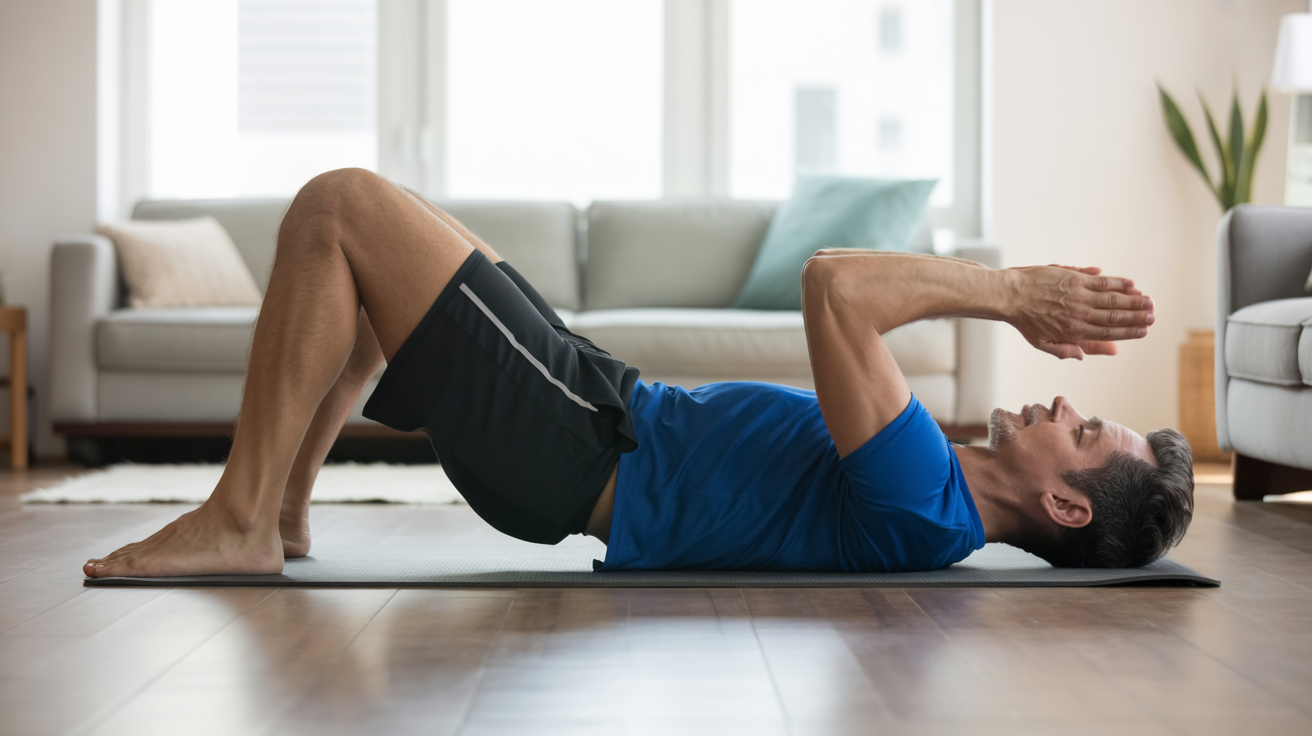
Lie on your back with your knees bent and feet flat on the floor. Imagine you're trying to prevent yourself from passing gas. The muscles you tighten are your pelvic floor muscles. You should feel a lifting and squeezing sensation deep in your pelvis.
What you should NOT feel:
- Your buttocks clenching
- Your thighs tightening
- Your abdominal muscles contracting significantly
- Holding your breath
If you're feeling any of these, you're engaging the wrong muscles. The pelvic floor contraction should feel internal and isolated—a subtle but distinct squeeze and lift.
Tip: Place one hand on your lower abdomen and one on your buttocks while practicing. Neither should move significantly during a correct pelvic floor contraction.
Your Step-by-Step Kegel Exercise Routine
Once you've identified your pelvic floor muscles, you're ready to start training. Here's a progressive routine designed specifically for men over 40:
Week 1-2: Building the Foundation
Basic contraction:
- Get into a comfortable position—lying on your back, sitting, or standing (all work equally well once you've mastered the technique)
- Tighten your pelvic floor muscles
- Hold the contraction for 3 seconds
- Relax completely for 3 seconds
- That's one repetition
Sets and frequency:
- 10 repetitions per set
- 3 sets per day (morning, afternoon, evening)
- Total daily time: approximately 3-5 minutes
Key principles:
- Breathe normally throughout—never hold your breath
- Focus on full relaxation between contractions (the relaxation phase is as important as the contraction)
- Quality over quantity: a proper 3-second hold is worth more than a sloppy 10-second one
Week 3-4: Building Strength
Increase the hold time to 5 seconds, with 5 seconds of relaxation between contractions. Maintain 10 repetitions per set, 3 sets per day.
Week 5-8: Advanced Training
Long holds: Work up to 10-second contractions with 10 seconds of relaxation. Aim for 10 repetitions, 3 sets per day.
Quick flicks: Add a set of rapid contractions—squeeze and release as quickly as possible for 10 repetitions. These train the fast-twitch muscle fibers that respond during sexual arousal.
Combined routine:
- 2 sets of long holds (10 seconds on, 10 seconds off × 10 reps)
- 1 set of quick flicks (rapid contractions × 10 reps)
- 3 times per day
When to Expect Results
Be patient and consistent. Most men begin to notice improvements in erectile quality within 4-6 weeks of consistent daily practice. More significant improvements typically emerge at the 3-month mark. Clinical studies showing the most dramatic results used 3-6 month protocols.
The key word is consistent. Doing Kegels for a week and then stopping will produce no lasting benefit. Think of it like any other muscle training—the results come from sustained, progressive effort over time.
Common Mistakes That Prevent Results
Mistake 1: Holding your breath
This is the most common error. Holding your breath creates intra-abdominal pressure that can actually work against pelvic floor function. Breathe normally throughout every exercise.
Mistake 2: Clenching the wrong muscles
If your buttocks, thighs, or abdomen are doing most of the work, you're not effectively targeting the pelvic floor. Go back to the identification techniques above and practice isolating the correct muscles.
Mistake 3: Skipping the relaxation phase
The pelvic floor needs to fully relax between contractions to develop proper function. A chronically tense pelvic floor can actually contribute to ED and pelvic pain. Give equal attention to the release as to the squeeze.
Mistake 4: Overdoing it
Like any muscle, the pelvic floor can be overtrained. If you experience soreness, fatigue, or increased symptoms, reduce your volume and allow recovery time. More is not always better.
Mistake 5: Expecting overnight results
Pelvic floor rehabilitation takes time. Men who give up after two weeks because they "don't see results" are abandoning the protocol before it has a chance to work. Commit to at least 8-12 weeks before evaluating effectiveness.
Building a Complete ED Recovery Plan
Pelvic floor exercises are powerful, but they work best as part of a comprehensive approach to erectile health. Here's how to integrate them into a broader strategy:
| Intervention | Action | Why It Works |
|---|---|---|
| Pelvic Floor Exercises | 3 sets daily, progressive protocol | Strengthens muscles that maintain erectile rigidity |
| Aerobic Exercise | 150+ minutes/week of brisk walking, cycling, swimming | Improves cardiovascular health and penile blood flow |
| Healthy Diet | Mediterranean-style eating pattern | Reduces vascular risk factors for ED |
| Weight Management | Target healthy BMI; even 5-10% weight loss helps | Improves hormone balance and reduces pelvic pressure |
| Sleep Optimization | 7-9 hours per night consistently | Critical for testosterone production and recovery |
| Stress Reduction | Daily mindfulness, deep breathing, or meditation | Reduces cortisol and performance anxiety |
| Limit Alcohol | No more than 1-2 drinks per day | Alcohol is a direct erectile suppressant |
| Quit Smoking | Seek support if needed | Smoking damages blood vessels critical for erections |
For a deeper dive into the lifestyle factors that affect erectile function, read our comprehensive guide to lifestyle changes for reversing ED naturally.
When to See a Doctor
Pelvic floor exercises are safe for virtually all men and have no significant side effects when performed correctly. However, there are situations where professional guidance is important:
See a doctor if:
- Your ED is sudden in onset (rather than gradual)
- You have other cardiovascular symptoms (chest pain, shortness of breath, leg pain during exercise)
- You have diabetes, hypertension, or other conditions that affect blood vessels
- You've had prostate surgery or treatment
- You're not seeing any improvement after 3 months of consistent practice
ED can be an early warning sign of cardiovascular disease—the same arterial narrowing that restricts blood flow to the penis often affects the heart and brain. Getting a medical evaluation is always worthwhile, not just for your sexual health but for your overall health.
A pelvic floor physiotherapist can also provide personalized guidance, biofeedback training, and more advanced techniques if self-directed exercises aren't producing results.
Combining Pelvic Floor Training with Natural Supplements
For men looking to accelerate their results, pelvic floor exercises can be combined with evidence-based natural supplements that support erectile function. Key ingredients to look for include:
- L-Arginine and L-Citrulline: Amino acids that boost nitric oxide production, improving blood flow to the penis
- Ginkgo Biloba: Supports circulation and may enhance the vascular response to sexual stimulation
- Panax Ginseng: Has clinical evidence for improving erectile function
- Zinc and Magnesium: Essential minerals for testosterone production and sexual health
For a comprehensive review of natural ED supplements, see our natural alternatives to Viagra guide and our shockwave therapy for ED overview for information on clinical treatments.
The Bottom Line: Take Control of Your Erectile Health
Erectile dysfunction is not an inevitable consequence of aging. It's a condition with identifiable causes and effective, natural treatments—and pelvic floor exercises are among the most powerful tools available.
The research is clear: consistent pelvic floor training can significantly improve erectile function in men over 40. It's free, it's private, it requires no equipment, and it can be done anywhere. The only thing standing between you and better erectile health is the decision to start.
Begin with the Week 1-2 protocol today. Three sets of 10 contractions, three times a day. That's less than five minutes of your time. In 8-12 weeks, you may be surprised by what a difference those five minutes can make.
For a comprehensive approach to men's sexual health after 40, explore all our evidence-based guides at Over40 Vitality. Consider VigRX Plus—a clinically studied supplement that complements natural ED treatments with proven botanical ingredients.